Physical education (P.E.) is critical in a young individual’s lifestyle. It leads children in the process of becoming healthy and physically active for the rest of their life.
I recently enrolled in a kinesiology class because I am planning to become an elementary teacher. Teaching P.E. sounds easy and almost effortless, however, it is suprisingly complicated. There are hundreds of games and many different subcategories to focus on. If you are interested, here’s a link I recommend to browse through: https://www.pecentral.org/lessonideas/elementary/k2lessonideas.asp
The game I will focus on today is called Dog Catcher. The purpose of this game is to teach your students about chasing and fleeing. Chasing is moving at high speed to catch up or tag a moving object or person. Fleeing is quickly moving away from an in motion object or person. The suggested grade level is K-2.
Materials needed:
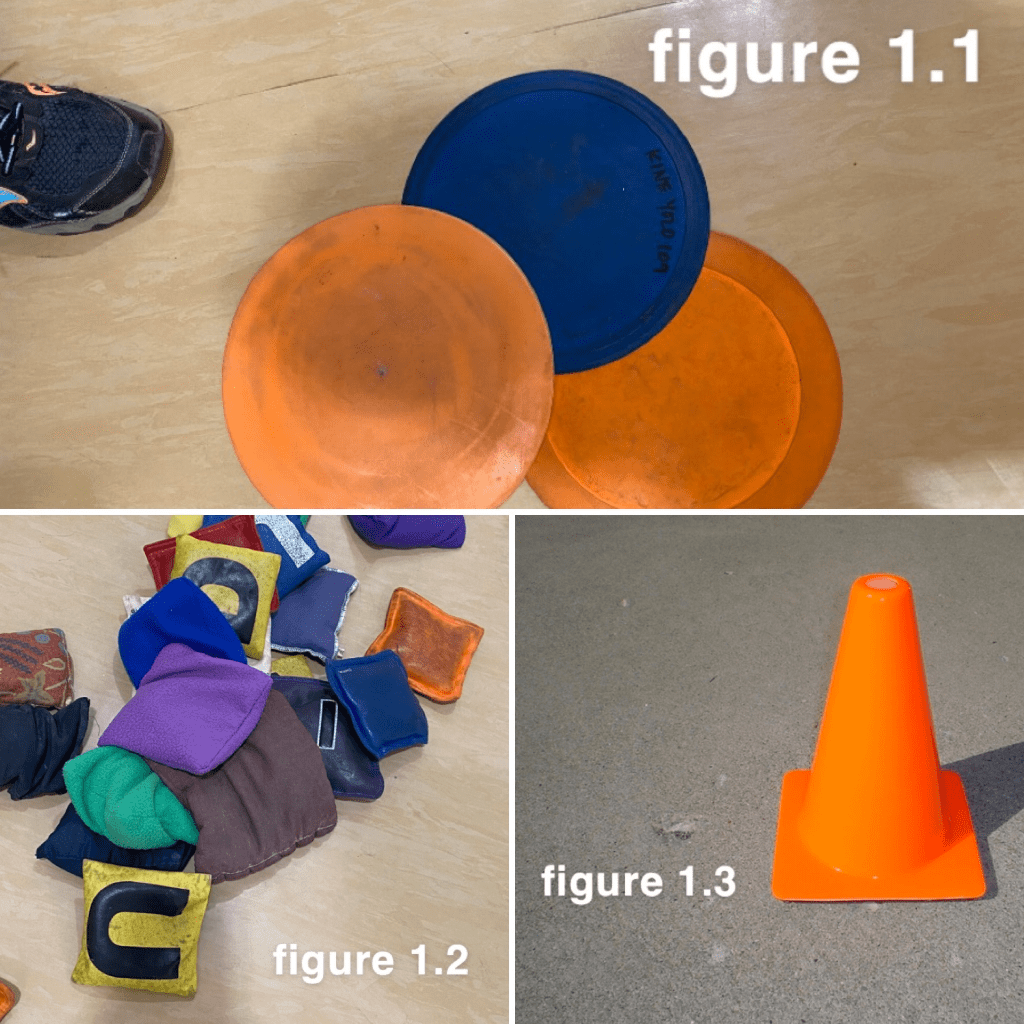
- 6 Poly spots (figure 1.1)
- 6-10 beanbags (figure 1.2)
- 4 cones (figure 1.3)
- 2 blue vests
- 2 red vests
Set up:
- Set up the 4 cones to make a “dog pound” at one end of the gym
- Spread out the “dog bones” (bean bags) all around the play area
- Lay out the “dog houses” (Poly spots) in the vicinity
- Choose 2 players to be the “dog catchers” (taggers) and give them each a blue vest
- Select 2 players to be the “cats” (helpers) and give them each a red vest
How to play
The dogs and cats expand around the playing area and the dog catchers start in the dog pound. On your signal, the dog catchers try to catch the dogs. When a dog is being chased he/she can hide in a dog house, however, once the dog isn’t being chased he/she must leave the dog house. The dog catcher is not allowed to “puppy guard” the dog houses and must leave a dog alone once he/she is in a dog house.
If a dog is caught they must go to the dog pound and wait for a cat to bring them a bone to eat. Once the dog has “eaten” the bone, he/she can escape by dropping off the bone in the play area. The dogs and cats are friends so they do not chase each other. Change the dog catchers, cats, and empty the dog pound every few minutes.
Tips/ Suggestions
- Make sure you show the children how to chase and flee
- Concentrate on one or two cues at a time while the activity is happening
- It is really important that after you explain the activity you start slow. Use walking first and then try hopping or other easier and slower locomoter movements
- Congradulate children chasing and fleeing correctly
- Come prepared!
- Jump in, play with the kids! They will most likely enjoy the game more if you (a role model) are actively involved
 How to teach a PE lesson to kindergartners